

Enhancing Data Center Cooling: A Four-Step Guide
Balancing cost efficiency with environmental responsibility may appear challenging, yet data centers present an exceptional opportunity to achieve both. As energy costs and demands in data centers rise, effective cooling strategies remain essential. By adopting best practices, you can enhance your data center’s cooling performance and future-proof it.
Step 1: Optimize Data Center Sealing
Effective sealing forms the backbone of an efficient cooling strategy in data centers. Poor sealing introduces humidity and leads to energy loss, undermining cooling efforts. Consider these steps for optimal sealing:
- Ensure doors remain closed consistently.
- Implement a vapor seal using materials such as plastic film, vapor-retardant paint, and vinyl coverings, which offer a cost-effective environmental control.
- Seal piping and cable entry points through walls and floors.
- Conduct a data center assessment to detect and address sealing issues.
Step 2: Implement Hot-Aisle/Cold-Aisle Configuration
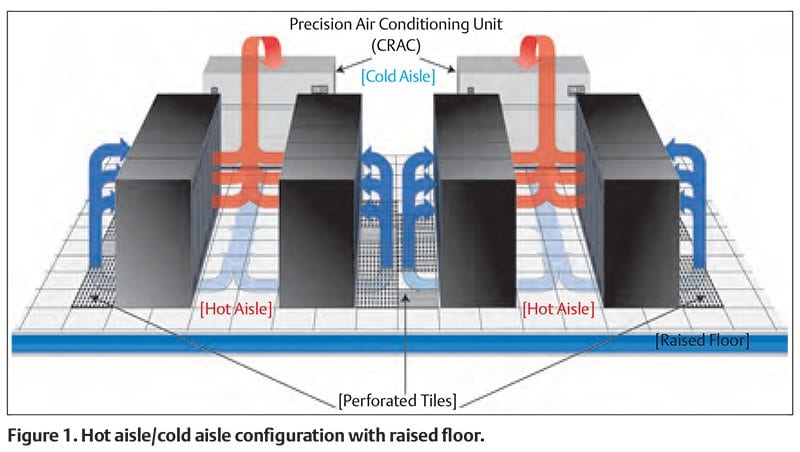 Hot-aisle/cold-aisle setups maximize the removal of heat from equipment with minimal energy use. This configuration enhances airflow and boosts the capacity of computer room precision air conditioning (CRAC).
By aligning racks to face each other and draw air from the cold aisle, hot air is efficiently expelled, creating a hot aisle. CRAC units, positioned perpendicular to hot aisles, effectively increase return air temperature, thereby boosting energy efficiency.
Step 3: Employ Aisle Containment Solutions
Following the establishment of a hot-aisle/cold-aisle layout, the next enhancement is aisle containment. This approach prevents the mixing of hot and cold air streams, which can degrade efficiency. Aisle containment can be achieved by installing barriers and doors at aisle ends, offering a low-cost, easy-to-install solution even in raised-floor scenarios.
This approach enhances both cooling capacity and CRAC efficiency by raising return air temperatures, enabling the cooling of greater heat loads per rack. For further insights, refer to the white paper on “Focused Cooling Using Cold Aisle Containment”.
Step 4: Adopt Intelligent Cooling Controls
Advanced cooling systems like the Liebert DSE optimize component operations to cut energy use while integrating diagnostics with management systems. The Liebert DSE offers up to 70% higher efficiency than typical technologies, utilizing dynamic fans, compressor modulation, and strategic sensor placement.
Liebert iCOM decouples compressor and fan operations, ensuring precise matching to IT load and airflow demands, thereby optimizing efficiency and avoiding unnecessary cooling.
Weber & Associates: Your Partner in Data Center Efficiency
With data center managers grappling with increasing energy consumption, implementing these strategies can significantly reduce cooling-related power use and support your energy objectives. Weber & Associates is dedicated to working with you to tailor a practical energy-saving plan for your organization. Many companies find that even minor adjustments can lead to substantial savings.
Frequently Asked Questions
- What is data center cooling? Data center cooling involves strategies and technologies used to maintain optimal temperatures within a data center, ensuring equipment operates efficiently and reliably.
- Why is a hot-aisle/cold-aisle configuration important? This setup improves airflow management and enhances cooling efficiency by effectively segregating hot and cold air streams, reducing the energy demand on cooling systems.
- How does aisle containment improve data center cooling? Aisle containment prevents the mixing of hot and cold air, thereby increasing cooling capacity and efficiency, allowing higher heat loads to be managed effectively.